Last week the village of Hyères at the French Riviera hosted the 27th International Festival of Fashion & Photography. In the impressive decor of the Villa Noailles young artist pave their way to international succes. It’s a very avant garde festival, a bohemian home where trends are set, where open minds come together to look at the future. No better location than this one, visited by many great names.
Villa Noailles is an early modernist house, built by architect Robert Mallet-Stevens for art patrons Charles and Marie-Laure de Noailles, between 1923 and 1927. It is located in the hills above Hyères, in the Var, southeastern France.
Charles de Noailles was born in 1891, and his wife Marie-Laure was born in 1902. They were married in 1923. Before their marriage, they became friends of artist-filmmaker Jean Cocteau, and Noailles commissioned a portrait of his wife by Pablo Picasso in 1923.
In 1923, they signed a contract with the architect Robert Mallet-Stevens to build a summer villa in the hills above the city of Hyères. Construction was underway for three years, and eventually also included a triangular Cubist garden designed by Gabriel Guevrekian.
Throughout the 1920s and 1930s, the couple were important patrons of modern art, particularly surrealism; they supported film projects by Man Ray, Salvador Dalí, and Luis Buñuel; and commissioned paintings, photographs and sculptures by Balthus, Giacometti, Constantin Brâncuşi, Miró, and Dora Maar. Villa Noailles features prominently in Man Ray’s film Les Mystères du Château de Dé.
Source: The Red List
Post by Coco Pastis
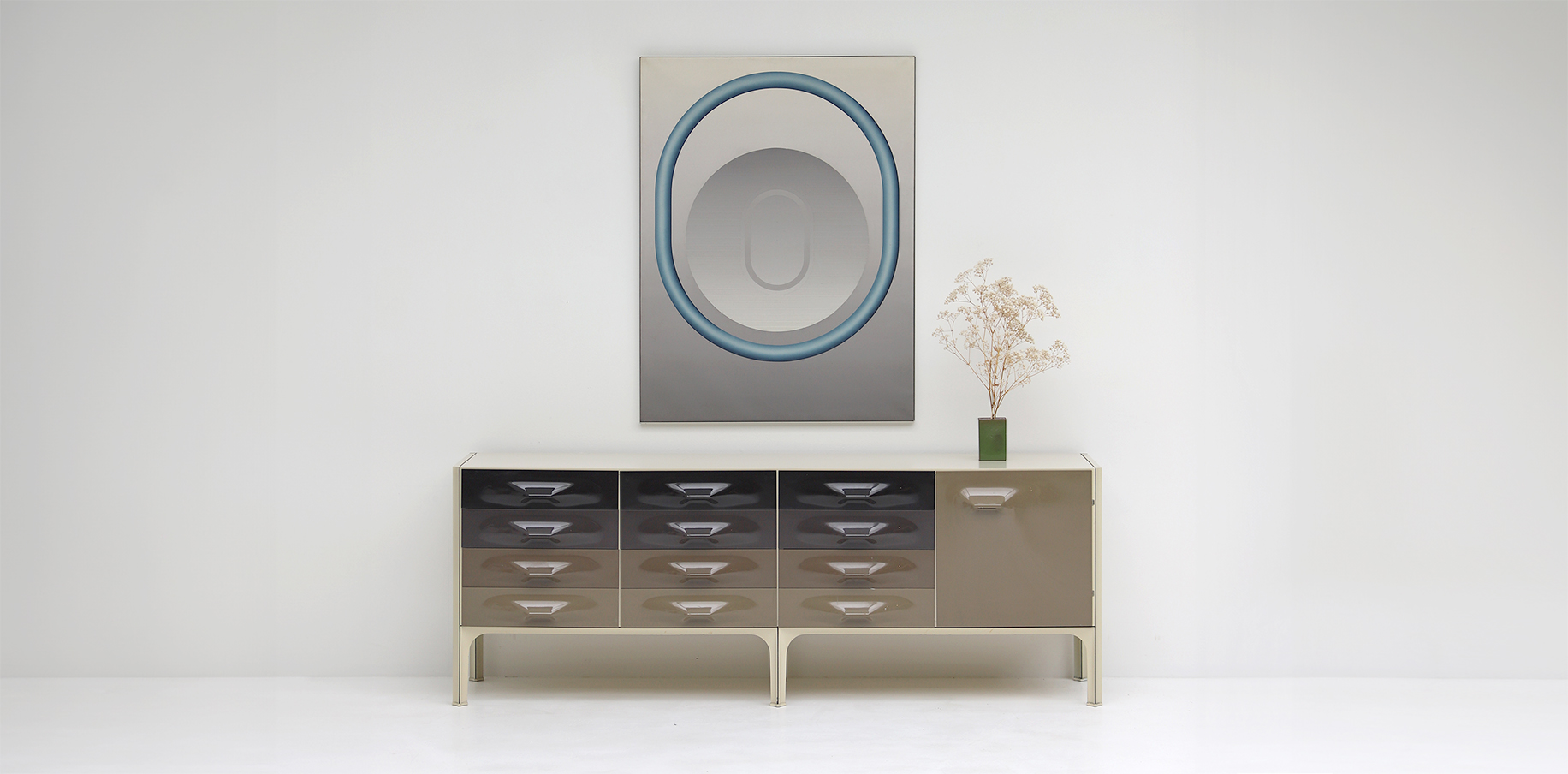
The Mobilier National is the successor to the Garde-Meuble de la Couronne (the entity originally responsible for the safeguarding of royal furnishings and tapestries), which was reorganized by Colbert in 1663; its structure still serves as the basis for the current administration’s organization. In addition to maintaining inventories and conserving and caring for furnishings, the Garde-Meuble de la Couronne also acted as an important force for preserving classic techniques through its traditional workshops. It was responsible for furnishing royal residences and issued the commissions necessary for these programs. This remains the central role for the Mobilier National, which is now responsible for the interior design and furnishing of presidential residences, as well as official buildings (ministries, embassies, major government agencies, the National Assembly, and the Senate).
In the early 1960s, the French government, under the leadership of André Malraux, then the Minister of Culture, inaugurated a policy of supporting creative endeavor; the objective was to provide genuine patronage that would foster the revival of French furniture design. As part of this commitment, the Atelier de Recherche et de Création (ARC) was established in 1964 under the direction of Jean Coural. The mission of this entity was to promote contemporary French styles, providing designers with modern technical resources and manufacturers with distribution opportunities, based on carefully directed research.
The ARC is a research laboratory with a highly qualified staff devoted to studying new materials and creating prototypes that are developed through collaboration with designers and in close cooperation with interested manufacturers. The design models remain the property of the government but may be subsequently distributed by a French producer.
The finest designers of the 1960s and 1970s worked with Mobilier National, and the most significant creations of the era were products of this venture. Since its inception, the ARC has produced over 500 pieces of furniture, including special commissions for french pavilions at expositions of Montreal and Osaka, presidential residences and offices, and more recently the French embassy in Berlin and the Ministry of Culture and of Communication.
Exhibition: Mobilier National, New York, November 8
– February 11, by Designer, for Demisch Danant
source : dailyicon.net
![]()
![]()
![]()
![]()
![]()
![]()
![]()
![]()
![]()
![]()
![]()
![]()
![]()
![]()
![]()
![]()
![]()
![]()
![]()
![]()
In the year 2008, the American designer George Nelson (1908-1986) would have celebrated his 100th birthday. To commemorate this occasion, the Vitra Design Museum exhibited the first comprehensive retrospective of his work. Nelson was one of the most influential figures in American design during the second half of the twentieth century. With an architectural degree from Yale, he was not only active in the fields of architecture and design, but was also a widely respected writer and publicist, lecturer, curator, and a passionate photographer. His office produced numerous furnishings and interior designs that became modern classics, including the Coconut Chair (1956), the Marshmallow Sofa (1956), the Ball Clock (1947) and the Bubble Lamps (1952 onwards).
As design director at Herman Miller, a leading US manufacturer of modern furniture design, Nelson had a major influence on the product line and public image of the company for over two decades. He played an essential role in bringing the company together with designers such as Charles Eames, Alexander Girard and Isamu Noguchi. Early on, Nelson was convinced that design should be an integral part of a company’s philosophy, and by promoting this viewpoint, he also became a pioneer in the areas of business communication and corporate design.
As an architect, designer and writer, Nelson was deeply interested in the topics of domestic living and interior furnishings. In the bestselling book Tomorrow’s House (1945, co-authored with Henry Wright), he articulated the groundbreaking concept of the “storagewall”. The walls of a house, Nelson explained, could be used to store things by transforming them into floor-to-ceiling, two-sided cabinets. A revolutionary idea at the time, it anticipated the flood of consumer goods that the economic boom in the western world would soon produce, turning the single-family home into a small warehouse.
Nelson designed several private homes, including a New York town house for Sherman Fairchild (1941, together with William Hamby) and Spaeth House on Southampton beach (1956, together with Gordon Chadwick). As a committed proponent of industrial building methods, Nelson published numerous texts on the topic of prefabricated architecture. In the 1950s he developed the “Experimental House”, a modular system of cubic volumes with Plexiglas roof domes which owners could assemble into personal habitations according to their own spatial requirements.
In addition to his preoccupation with architecture and the domestic interior, Nelson intently pursued the topic of office furnishings. Besides designing the first L-shaped desk, he played a major role in the development of Herman Miller’s Action Office, and in the 1970s he created his own office system, Nelson Workspaces. Similar to Nelson’s home furnishings and experimental architecture, this system was based on a variety of modular elements that could be freely combined.
The extraordinary diversity of design tasks taken on by the Nelson office extends far beyond the field of furniture design, although the latter forms the basis of his reputation today. Numbering among his clients were many large corporations including Abbott, Alcoa, BP, Ford, Gulf, IBM, General Electric, Monsanto and Olivetti, as well as the United States government. In his New York office, which he established in 1947 and ran for more than three decades, Nelson employed over fifty people at times, including familiar figures such as Ettore Sottsass and Michael Graves. Along with exhibitions, restaurant interiors and showrooms, George Nelson & Company designed kitchens, flatware and dishes, record players and speakers, birdhouses and weathervanes, computers and typewriters, company logos and packaging, rugs and tiles.
George Nelson Installation, at Vitra Design Museum, Photography: © Thomas Dix, © Vitra Design Museum Archiv
source : dailyicon.net
LAMA & YHBHS partner to present a three-week interior showcase at the LAMA Showroom. Now open to the public, for 3 weeks, until the auction, Oct 9, 2011.
“David John of the acclaimed arts and interiors blog You Have Been Here Sometime (YHBHS) will design and style a temporary interior space, the first of its kind, at the LAMA showroom that will showcase a fresh and current perspective of Dorso’s lifelong collection. Utilizing David John’s skills as an interior designer, LAMA has invited this local California designer to create an intimate space that brings together the past and present, shining a light on how Modern Art and Design is viewed in today’s current art and interiors scene.
Collecting in Los Angeles 1945 – 1980 is an exhibit that explores the collecting practices of Richard Dorso and brings together important works that create a unique snapshot of the post-WWII Los Angeles art scene, all through the eyes of one collector.
The exhibit will conclude with a one-owner auction of The Collection of Richard Dorso featuring over 400 works of art spanning much of the 20th century. ”
Exhibit and Preview Dates:
September 19 – October 8, 2011; open daily 10am – 6pm
Auction Date: October 9, 2011; 12pm Noon (PST)
Los Angeles Modern Auctions is a participating gallery in
Pacific Standard Time: Art in L.A. 1945 – 1980
16145 Hart St. Van Nuys, CA 91406 | 323-904-1950 | www.lamodern.com
images by Bethany Nauert.
source : http://youhavebeenheresometime.blogspot.com/
After some deliveries in Paris i visited the exhibition at Artcurial. I must say that i was impressed of the well selected 12 french interior designers. single entrance for the “Interiors 2011, the art of living with art” 7 euro and 10 euro with a AD magazine that is dedicated to this exhibition. 3 floors full with inspiring ideas. Each room nicely decorated and personalized by visionary highest award interior designers. here the 12 selected people : India Mahdavi, Olivia Putman, Roxane Rodriguez Alain Demachy, François-Joseph Graf, Shahan Minassian, Peter Jovanovich, Jean-Louis Deniot, Buttazzoni Lawrence & Associates, Joseph Dirand, Tristan Auer, Thierry Lemaire.
From September 12 to 22 at Hôtel Marcel Dassault, 7 rond-point des Champs-Elysées, 75008, Paris
Pictures : Lenz Vermeulen
Jean Prouvé 1901-1984: Industrial Beauty September 1, 2011, Ivorypress Art + Books presents the show Jean Prouvé 1901-1984: Industrial Beauty, dedicated to the outstanding
French engineer, artisan and designer Jean Prouvé (Paris, 1901 – Nancy, 1984).
JEAN PROUVÉ 1901-1984, AV Monografías 149, 2011
This AV/Arquitectura Viva monograph accompanies the exhibition Jean Prouvé 1901-1984: ‘Industrial Beauty’, on view at Ivorypress Art + Books from 1 September to 12 November 2011. The publication opens with a summary of the content by one of the curators, Luis Fernández-Galiano, and further consists of three parts, each one containing several essays and interviews:
“The first part – Preambles – presents a full biographical account and analyzes Prouvé´s first professional years in Nancy. The second part – Processes – concentrates on the construction techniques as well as his façades and achievements in sustainable design and industrialized housing. Under the title Practices the publication deals in depth with the phase in Maxéville (known as his mature years) and the time after in which Prouvé conceived masterful buildings, components and was active as professor and as consultant. The publication includes texts by Catherine Prouvé, Peter Sulzer, Ignacio Paricio and Norman Foster among many others.”
IVORYPRESS ART+BOOKS SPACE I & SPACE II C/Comandante Zorita 48 – 46 28020 Madrid. Spain. T: +34 91 4490961 F: +34 91 570 98 64 space@ivorypress.com
youhavebeenheresometime.blogspot.com/
image courtesy of galerie patrick seguin and ivory press
Buy this book on Amazon
canon EOS Rebel T1i
Dear iDEALS, Polaroid technology revolutionized photography. In nearly all photographic areas – from landscape and genre, portrait and self-portrait, fashion and nudes – this unique imaging process has found enthusiastic devotees all over the world. Helmut Newton used the technology intensively starting in the 1970s, especially for his fashion photo shoots.
As he once described in an interview, this satisfied his impatient urge to want to know immediately how a certain situation would look as a photograph. In this context, the Polaroid acted as an idea sketch in addition to testing the actual lighting situation and image composition.
Newton’s additional notes, written on the edges of the Polaroids, are fascinating as well as revealing with regard to the model, client or location and date.The comments, the haziness of the images and the signs of use are naturally also to be found on the enlargements of the Polaroids included in the exhibition; they testify to a pragmatic approach to the original work materials, which have now possess an own inherent value.
For the first time ever, over 300 works based on the original Polaroids offer a comprehensive overview of this aspect of Newton’s oeuvre.The exhibition is thus a look into the sketchbook of one of the most influential photographers of the 20th century.
source : filepmotwary.com
buy this book on Amazon
With the ‘Design and the Modern Interior’ exhibition at Pallant House Gallery about to draw to a close, we thought we’d better nip down to Chichester tout suite. The exhibition, which brings together the furniture designs of Robin Day and textile designs of his wife Lucienne, was a complete joy to behold, with three rooms dedicated to a truly wonderful collection of fabrics by Lucienne, many of which were cunningly used as a backdrop to complement some of Robin Day’s most iconic pieces of furniture.
source : chairsmith.blogspot.com
![]()
![]()
![]()
![]()
![]()
![]()
Prouvé RAW is a collection of newly interpreted furniture classics from French designer and artisan Jean Prouvé. The designs of Jean Prouvé have been a source of inspiration for the creative team at G-Star for quite some time. This appreciation of and fascination with the artist was the starting point for Prouvé RAW in collaboration with Vitra. Thanks to the cooperation of G-Star, the Prouvé family and Vitra, Prouvé’s most famous designs have been re-issued with a contemporary flair, while some of his lesser-known designs have been rediscovered.
Jean Prouvé by G-Star Raw, June 15th – July 31st, daily 12 – 2:00 pm, at the Fire Station by Zaha Hadid on the Vitra Campus in Weil
source : dailyicon.net